
Learning from Human Interactions
Stabilized pointflow bridges human and robot interactions.
Action-conditioned world models offer a promising foundation for generalist robotic intelligence by predicting the consequences of actions. However, existing robotic datasets provide limited coverage of the diverse interaction dynamics required for generalizable world modeling. Large-scale egocentric human videos offer complementary interaction experience, yet the embodiment gap between human hands and robotic manipulators hinders effective cross-embodiment learning. Meanwhile, the predominance of successful demonstrations leaves failure dynamics substantially underrepresented, limiting the ability of world models to anticipate unsuccessful executions. To address these limitations, we introduce HF-WM, an action-conditioned world model that combines Human interaction learning with Failure-aware post-training. To bridge the embodiment gap, we develop a dual-branch framework that couples video generation with auxiliary pointflow prediction, using stabilized pointflow as a unified motion representation across human and robot interactions while suppressing egocentric camera motion. To improve failure modeling, we further perform Group Relative Policy Optimization (GRPO) post-training on perturbed actions derived from successful demonstrations, guided by action alignment and physics plausibility rewards, enabling the model to learn plausible failure dynamics without paired ground-truth videos. Extensive experiments demonstrate that HF-WM achieves state-of-the-art performance in action-conditioned video generation and exhibits strong utility for policy evaluation in downstream robotic tasks.
Each row shows frame-aligned input action skeletons, generated RGB rollouts, and corresponding pointflow visualizations.
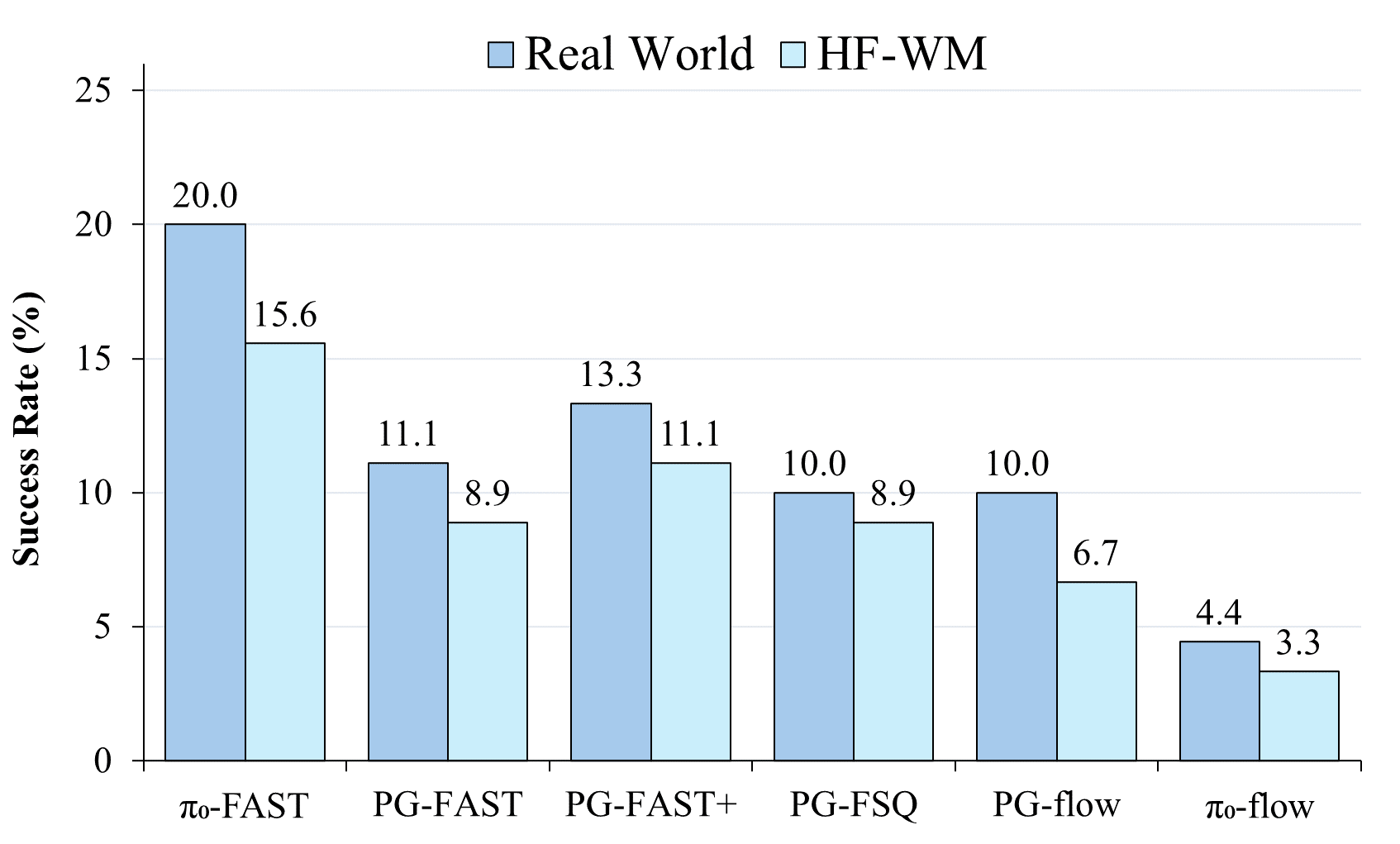
HF-WM is used as a real-world policy evaluator on six RoboArena policies. For each session it receives only the initial observation and the policy action sequence, then autoregressively rolls out the future interaction. Task success is scored from these generated videos, and the resulting policy rates track real-world deployment with Pearson r = 0.983.
Place the square on the plate.
Put the green cube in the pink bowl.
At test time, HF-WM generates candidate futures for sampled actions and Robometer scores them before execution. Selecting the higher-scoring action shortens the executed trajectory relative to the π0.5 baseline, as shown in the two LIBERO-90 examples below.

Counterfactual actions expose failure dynamics; GRPO keeps the rollout that remains physically plausible.
This control case keeps the original action unchanged.
Physics-only scoring prefers nearly static or physically valid scenes, even when the robot no longer follows the conditioning action.
Alignment-only scoring keeps the robot consistent with the action, but background flicker and broken contact dynamics remain.
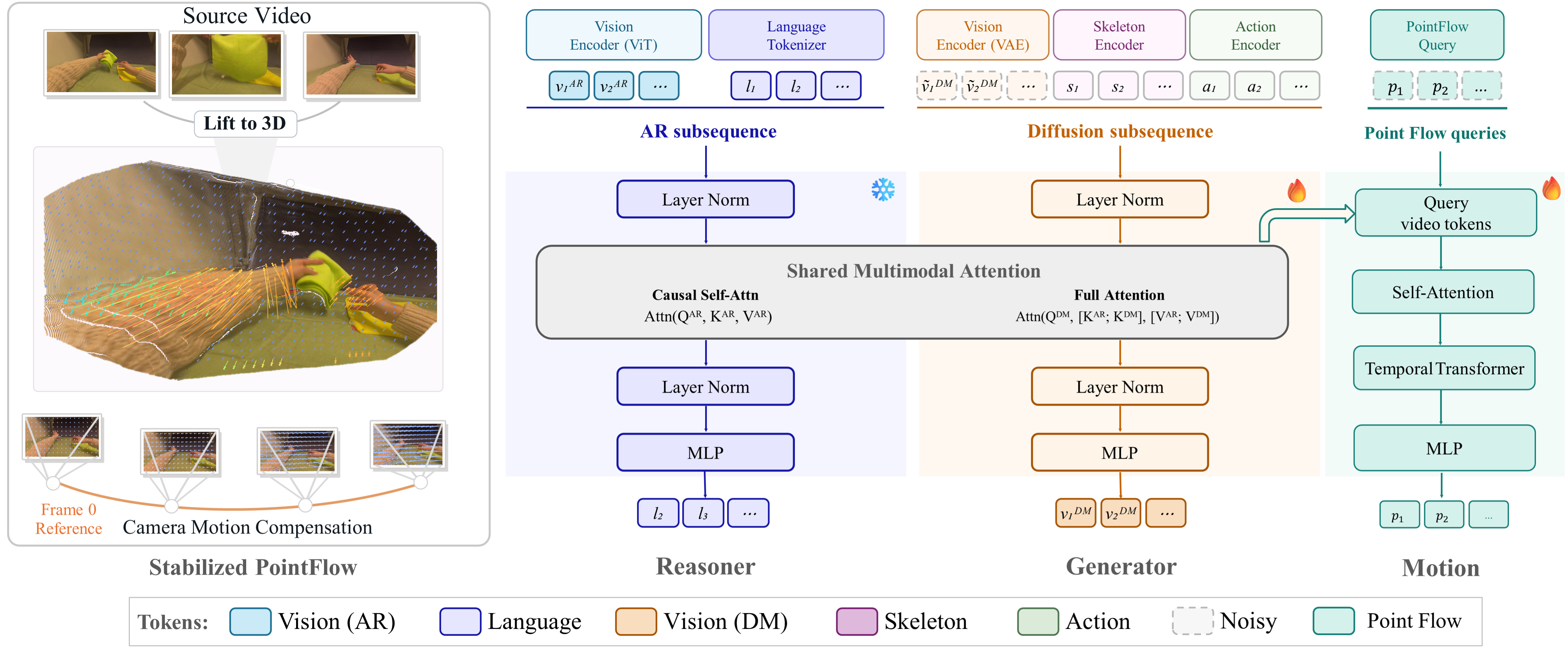
Left: camera-compensated 3D pointflow tracks object and gripper motion. Right: multimodal attention fuses vision, language, skeleton, action, and point-flow tokens for unified human–robot modeling.